Supply Chain Attack on CPU-Z: How AI-Powered EDR Stopped a Watering Hole in Its Tracks
Introduction: A Trusted Download Portal Turned Weapon
On April 9, 2026, users visiting cpuid.com to download the popular CPU-Z utility encountered something unexpected: the official download button was silently serving malware. For approximately 19 hours, threat actors had infiltrated the CPUID domain at the API level, intercepting legitimate download requests and redirecting them to attacker-controlled servers. Even users who navigated directly to the official site received a binary that was properly signed and appeared genuine—but it carried a malicious payload hidden inside. This wasn't a phishing email or a suspicious link; it was a direct attack on the software supply chain, exploiting the trust users place in well-known vendor infrastructure.

The Compromise: How the Attack Unfolded
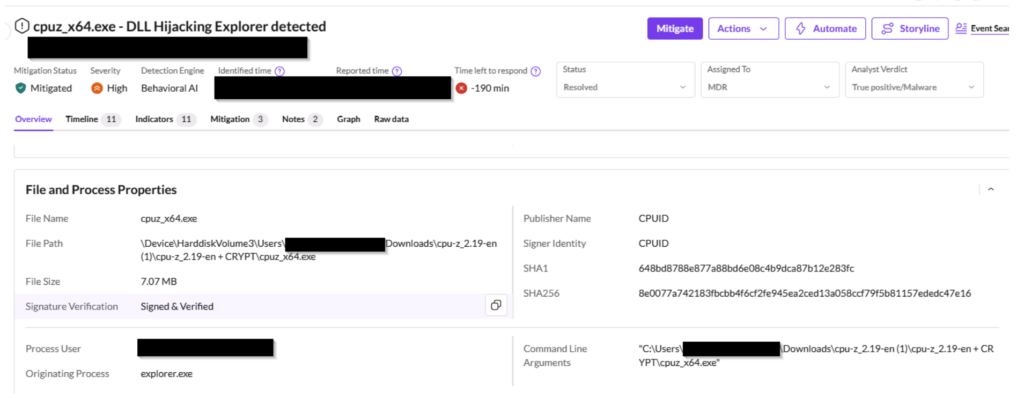
The attack targeted cpuid.com, the home of CPU-Z, HWMonitor, HWMonitor Pro, and PerfMonitor—tools that are staples in the IT toolkit of enthusiasts, system administrators, and security professionals. The attackers compromised the vendor's API, allowing them to intercept legitimate download requests and serve a tampered binary. The binary passed digital signature checks and originated from the vendor's own infrastructure, making it nearly indistinguishable from a safe download.
Once executed, cpuz_x64.exe began a suspicious process chain: it spawned PowerShell, which then launched csc.exe (the C# compiler), which in turn executed cvtres.exe. This sequence of events is entirely atypical for CPU-Z, which normally does not invoke scripting engines or compilers. The trust chain—vendor → signed binary → user—had been broken above the user's level. Users had followed every recommended security practice, yet the malware still reached their systems.
Behavioral Detection: What the SentinelOne Agent Saw
SentinelOne's AI-powered endpoint detection and response (EDR) agent flagged the anomalous behavior within seconds of execution. The alert, titled “Penetration framework or shellcode was detected,” was triggered by a convergence of five specific behavioral indicators:
- Anomalous API resolution: The process located system functions through non-standard discovery methods, bypassing the operating system's loader entirely.
- Reflective code loading: Executable code was running in memory regions with no corresponding file on disk, a classic sign of fileless malware.
- Suspicious memory allocation: The process requested Read-Write-Execute (RWX) memory permissions—a staging pattern commonly used to prepare for malicious payload injection.
- Process injection patterns: Execution flow shifted in a way consistent with code being redirected into a secondary process to mask the origin of the attack.
- Heuristic shellcode signatures: Sequential operations characteristic of automated exploitation toolkits were detected, indicating that the malware was preparing its environment for command execution.
These indicators did not rely on known signatures or hashes; instead, the agent analyzed what the process was doing in real time. This behavioral approach allowed SentinelOne to detect the attack even though the binary was legitimate and signed.
The Broader Shift in Supply Chain Attacks
The CPU-Z incident is not an isolated event. SentinelOne's Annual Threat Report identifies a systemic shift: “This shift extends deeply into the software supply chain, where the identity of a trusted developer becomes the vector of attack.” In late 2025, the GhostAction campaign demonstrated this pattern when a compromised GitHub maintainer account pushed malicious workflows designed to extract secrets from repositories. Similarly, a concurrent phishing attack against a maintainer of popular NPM packages deployed malicious code that could intercept cryptocurrency transactions.
In each case, the commit logs and push events appeared entirely legitimate because they originated from accounts with valid write access. The identity was verified, but the intent had been subverted. The CPU-Z attack extends this pattern to software distribution itself: the supplier's download infrastructure became the delivery channel. Threat actors are increasingly targeting the trust layers that users rely on, making traditional signature-based defenses ineffective.
As users, we are conditioned to trust official websites and signed binaries. This attack exploited that trust at every level. The next attack will likely follow a similar blueprint—compromising a trusted source and delivering malware through channels that appear safe.
Autonomous Response: Stopping the Attack Before Damage
Seconds after detecting the anomalous behavior, SentinelOne's agent autonomously terminated and quarantined all involved processes. The malicious payload—a CRYPTBASE.dll placed in the application's directory—was prevented from executing fully. Because the response was automated, no human intervention was required, and the attack was neutralized before it could escalate to data theft, lateral movement, or ransomware deployment.
This incident highlights the critical importance of behavioral-based detection and autonomous response in the modern threat landscape. With supply chain attacks becoming more sophisticated, organizations must move beyond traditional antivirus and rely on AI-driven EDR platforms that can analyze process behaviors, memory patterns, and chain-of-execution anomalies in real time.
Conclusion: A New Standard for Endpoint Security
The CPU-Z watering hole attack serves as a stark reminder that trust is a vulnerable commodity in the software supply chain. SentinelOne's successful detection and autonomous response demonstrate that even when the attacker has the upper hand—compromising a legitimate vendor's infrastructure and signing chain—behavioral AI can still spot the anomalies that indicate malicious intent. By focusing on what a process does rather than what it looks like, organizations can defend against attacks that bypass all traditional checks. The future of endpoint security lies in zero-trust execution monitoring, where every action is scrutinized and every deviation is met with immediate, autonomous action.
As threat actors continue to target supply chains, the ability to detect and block attacks based on behavior—not reputation—will become an essential component of every organization's cybersecurity strategy.