Ransomware Attacks Hit Historic Highs in Q1 2026 as Ecosystem Consolidates Around Elite Groups
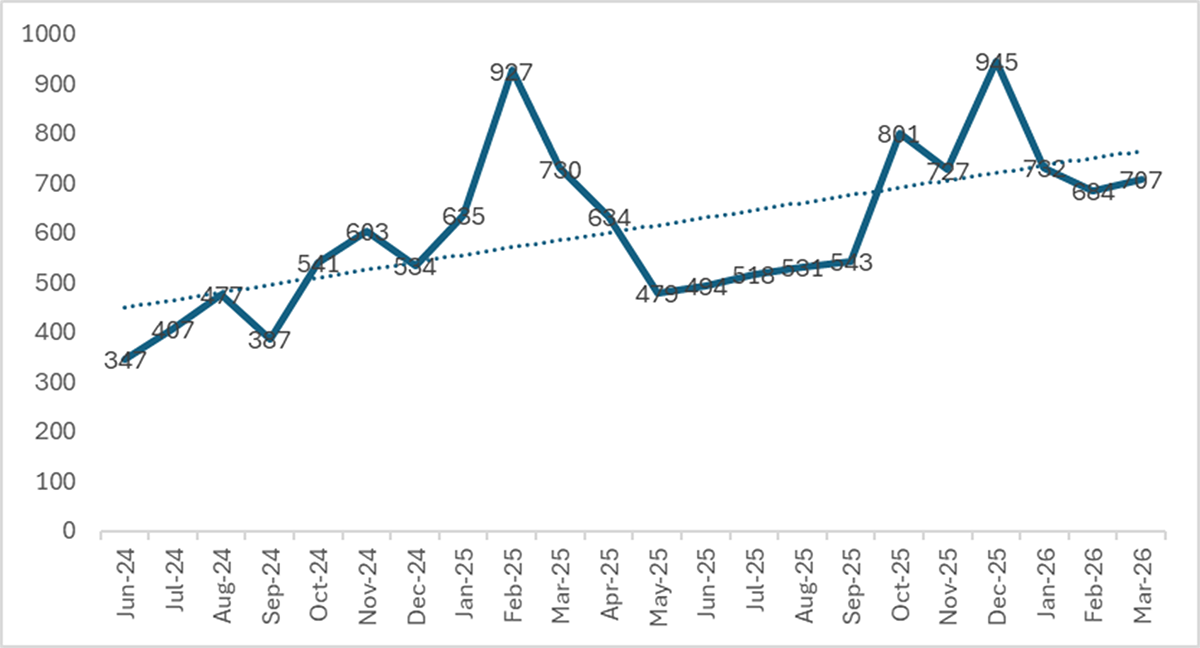
A staggering 2,122 ransomware victims were posted on data leak sites (DLS) in the first quarter of 2026, making this period the second-highest Q1 on record, according to new research published today.
The volume represents a 12.2% drop from the Q4 2025 all-time record of 2,416 victims, but remains 117% above Q1 2024 levels (977 victims).
"This isn't a decline—it's a stabilization at an extremely high baseline," said Dr. Elena Voss, lead threat analyst at CyberRisk Labs. "The underlying growth trend in ransomware persists, even if the most dramatic mass-exploitation spikes have subsided."
Key Findings
- Consolidation after peak fragmentation: The top 10 ransomware groups accounted for 71% of all Q1 2026 victims, a sharp reversal from the fragmentation seen in Q3 2025.
- Volume stabilization: Monthly volumes were consistently stable—732 in January, 684 in February, and 706 in March—averaging 707 per month.
- Qilin’s sustained dominance: Qilin maintained its position as the most prominent ransomware operation for the third consecutive quarter, posting 338 victims.
- The Gentlemen’s breakout: The group surged from 40 victims in Q4 2025 to 166 in Q1 2026, claiming third place globally.
- LockBit 5.0 comeback: LockBit posted 163 victims, climbing to fourth place.
"The consolidation we're seeing is unprecedented in recent years," noted Marcus Chen, senior threat researcher at SecuroMetrics. "After two years of fragmentation, the ecosystem is now coalescing around a handful of dominant operators."
Background
During Q1 2024, there were only 51 active ransomware groups, and the top 10 accounted for 68% of victims. By Q3 2025, the number of groups had surged to 85, and the top-10 share had fallen to 57%—a period of rapid fragmentation.
But in Q1 2026, the number of active groups shrank to 71. Fourteen groups that were active in Q4 2025 disappeared entirely, while 21 new names emerged. The top-10 share jumped to 71.1%, the highest concentration since Q1 2024.
Year-over-year comparisons initially show a 7.1% decline from Q1 2025 (2,285 victims). However, that figure was inflated by Cl0p’s Cleo mass-exploitation campaign, which contributed roughly 390 victims in a single burst. Excluding Cl0p, victims rose from 1,894 in Q1 2025 to 1,995 in Q1 2026—a 5.3% increase.
What This Means
The consolidation around elite groups signals a more professionalized and resilient ransomware ecosystem. Fewer operators, but with stronger affiliate networks and more sophisticated tactics, mean attacks will likely be more impactful.
"Smaller groups are either being absorbed or forced out," said Dr. Voss. "For defenders, this means the threat landscape is becoming less noisy but more lethal."
Organizations should expect continued high-volume attacks from dominant groups like Qilin, The Gentlemen, and LockBit. The return of LockBit 5.0 after law enforcement takedowns underscores the adaptive nature of these criminal enterprises.
"This is not a return to normal—this is the new normal," warned Chen. "The baseline is permanently elevated, and consolidation will only intensify."
For more details, refer to the Key Findings section or the Background on recent trends.