Closing the GenAI Gender Gap: Insights from Coursera’s Latest Report
As International Women’s Day approaches, a new report from Coursera examines how the gender gap in generative AI (GenAI) learning has evolved over the past year. The findings reveal encouraging progress globally, alongside persistent regional disparities. Below, we answer key questions about the report’s insights, from shifting enrollment patterns to the implications for economic equity and skill development.
1. What are the main findings of Coursera’s report on the gender gap in GenAI skills?
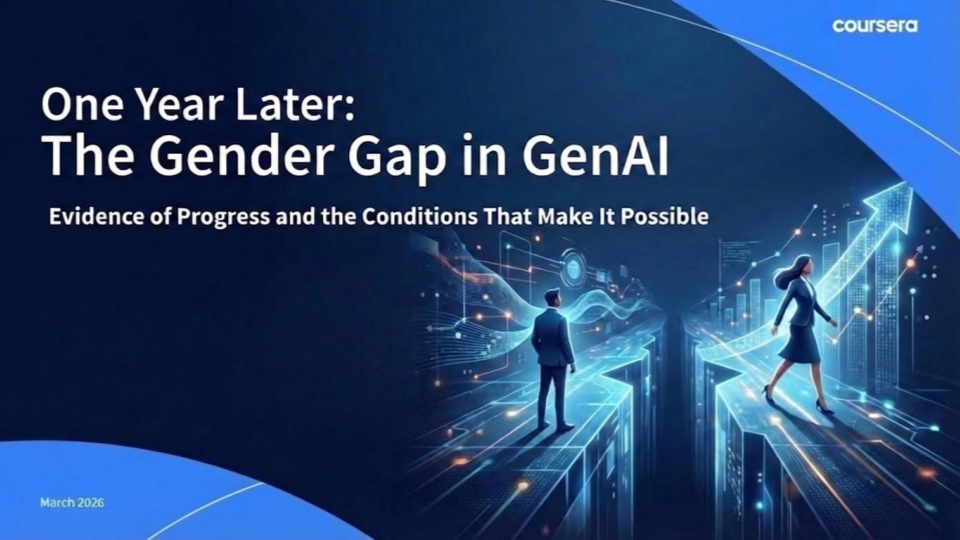
Conducted one year after Coursera’s initial analysis, the report tracks whether women are catching up in GenAI learning. Globally, women’s share of GenAI course enrollments rose from 32% in 2024 to 36% in 2025, signaling a narrowing gap. In enterprise settings, the shift is even more pronounced: women accounted for 36% of enrollments in 2024 and 42% in 2025—a faster growth rate than male peers. However, regional differences are stark. Latin America and Asia Pacific countries show strong gains, while many English-speaking, developed economies (e.g., United States, Canada, United Kingdom) saw women’s share decline slightly. The report underscores that GenAI adoption is accelerating overall, but without targeted interventions, existing inequities may persist.
2. How has women’s participation in GenAI learning changed globally and in enterprise environments?
Women’s engagement with GenAI courses grew faster than men’s over the past year. On the global platform, female enrollment share increased by 4 percentage points (from 32% to 36%). Within enterprise learners, the jump was 6 percentage points (from 36% to 42%). This trend is especially significant because total GenAI enrollments surged across all demographics, meaning women’s relative growth outpaced men’s. The data suggests that targeted corporate training programs may be effective in closing the gap. Yet overall representation remains below parity, highlighting the need for continued efforts to encourage women’s participation in emerging tech fields.
3. Which countries and regions lead in narrowing the GenAI gender gap on Coursera?
Several nations stand out for their rapid progress. In Latin America, countries like Peru (+14.5 percentage points year-over-year), Mexico (+5.3), and Colombia (+4.5) have doubled women’s share of GenAI enrollments. In Asia Pacific, Uzbekistan recorded an impressive 8.8 percentage point gain, while India (Coursera’s largest GenAI market) saw a 2.2 percentage point increase. Vietnam, Indonesia, Thailand, and the Philippines also posted year-over-year improvements. These gains often correlate with government or institutional investments in digital upskilling, as well as cultural shifts promoting critical human competencies alongside technical skills. The report emphasizes that regional policies and educational initiatives can significantly influence gender parity in advanced technology learning.
4. Why are some English-speaking, economically developed countries seeing a decline in women’s GenAI enrollment share?
In the United States (-0.9 percentage points), Canada (-1.0), United Kingdom (-1.8), Spain (-1.1), and Germany (-0.2), women’s share of GenAI enrollments decreased from 2024 to 2025. This may be due to a surge in male enrollments driven by early adoption in tech-heavy industries, rather than an absolute drop in female participation. In these economies, men may have faster access to professional development budgets or informal learning communities. Additionally, deeply ingrained structural barriers—such as gender stereotypes and lack of female role models in AI—could slow women’s uptake. The report suggests that without proactive measures, even affluent nations risk widening the gender gap in cutting-edge skills.
5. What is the broader economic significance of closing the gender gap in GenAI skills?
IDC research cited in the report estimates that GenAI could increase global wealth by up to USD $22.3 trillion by 2030. For these gains to be distributed fairly, all individuals—regardless of gender—must have the skills to harness GenAI. If women remain underrepresented, they may miss out on high-paying job opportunities and economic mobility. Conversely, closing the gap can boost innovation, productivity, and diversity in AI development, leading to more inclusive technologies. The report underscores that institutional action is essential to ensure equitable participation in the AI-driven economy.
6. Does the report address skills beyond GenAI, such as critical thinking?
Yes, the report highlights progress in narrowing gender gaps across critical skill domains, including generative AI and essential human competencies like critical thinking. While the primary focus is on GenAI, the data shows that women are also increasing enrollments in courses that build analytical, problem-solving, and interpersonal skills. These human-centric abilities complement technical expertise and are valued in future-proof careers. The report suggests that promoting a balanced skill set—both technical and foundational—can help women thrive in rapidly evolving fields. However, detailed breakdowns for critical thinking enrollments were not provided, leaving room for further analysis.
7. What recommendations does the report offer for institutions to accelerate gender parity in GenAI learning?
While the report does not prescribe explicit actions, its findings imply several strategies. Institutions should invest in targeted outreach to women, especially in regions where gaps are widening. Enterprise training programs that include mentorship and flexible learning paths may help sustain the progress seen in corporate environments. Governments can fund scholarships and awareness campaigns, as observed in top-performing Latin American and Asian countries. Employers should ensure equal access to professional development budgets and combat unconscious bias in AI-related roles. The report also encourages monitoring enrollment data year-over-year to identify gaps early. Ultimately, closing the gender gap requires coordinated effort from educators, policymakers, and company leaders to make GenAI skills accessible to everyone.